
Second Story vs. Side vs. Rear Addition: Which Is Right for Your Naples Home?
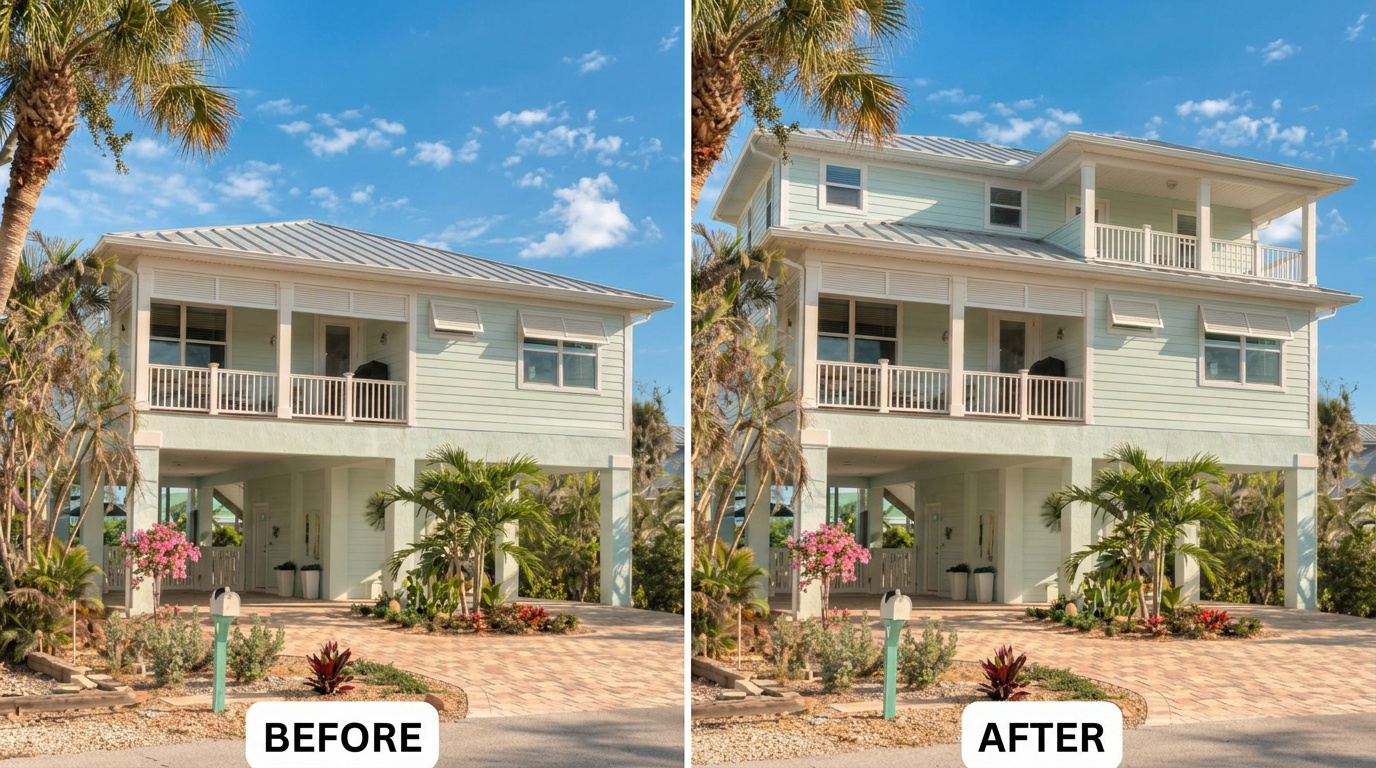
You've decided to add to your home rather than move. Good. For most Naples homeowners planning to stay 5+ years, that's the right call — see our full addition vs. moving analysis for why.
But now you face the next decision: which direction do you add? Up (second story), out to the side, or out to the back?
Most contractors will tell you "it depends" and move on. That's not useful. The honest answer is: there's a right direction for your specific home, and it's usually clear once you weigh five factors — lot geometry, HOA rules, neighborhood comps, intended use, and your appetite for disruption during construction.
This guide walks the three options side-by-side so you can see exactly which one fits your situation.
The Three Options at a Glance
| Factor | Second Story (UP) | Side Addition | Rear Addition |
|---|---|---|---|
| Cost per sqft (Naples) | $250 – $400 | $180 – $280 | $200 – $300 |
| Typical 1,000 sqft cost | $250K – $400K | $180K – $280K | $200K – $300K |
| Timeline (construction) | 5–8 months | 3–5 months | 4–6 months |
| Lot space required | None | Significant side yard | Significant backyard |
| Existing home disruption | Severe (roof removed) | Moderate | Moderate |
| Can you live in home? | No for 6–8 weeks | Usually yes | Usually yes |
| ROI (resale recovery) | 70–85% | 60–75% | 65–80% |
| Permit complexity | High | Medium-High | Medium |
| HOA approval likelihood | Lower | Medium | Higher |
| Best for | View capture, no lot space | Side bedroom suite, garage extension | Family room, kitchen expansion, pool integration |
These are 2026 Naples numbers. They include design, permits, mid-tier finishes, and hurricane code compliance. They do NOT include high-end fixtures, custom millwork, or extensive landscaping.
When to Go UP (Second Story Addition)
Going up makes sense when you've run out of lot. Naples homes on smaller lots — typical in older neighborhoods like the Moorings, Old Naples, and parts of Park Shore — often have setback rules that leave no room to expand horizontally. In those cases, the only buildable direction is vertical.
A second story also wins when the view matters. Adding a master suite on the second floor of a Pelican Bay home can pull in Gulf views that didn't exist before. That kind of value capture doesn't happen with a side or rear addition.
But going up is expensive — typically $250–$400 per square foot in Naples versus $200–$300 for horizontal expansion. The cost premium comes from three places: foundation reinforcement (about 60% of pre-2000 Naples homes need it), the full roof removal and rebuild required, and the hurricane engineering that has to certify a brand new vertical load path. Add 6–8 weeks of unlivable construction time on top of standard timeline, and you're looking at temporary housing costs of $6,000–$15,000 most families don't budget for.
Go up when:
- Your lot is small or fully built out
- A second-floor view would justify the cost
- Your HOA prohibits ground-floor expansion (some Naples communities do)
- You want to preserve outdoor space for pool, garden, or entertaining
Skip going up if:
- You have yard space available
- You want faster construction
- Your foundation condition is questionable
- You can't relocate for 6–8 weeks during construction
For the full cost breakdown specific to second story builds, see our second story addition cost guide.
When to Go OUT to the SIDE (Side Addition)
Side additions are the cheapest direction per square foot — and the most overlooked. Naples homeowners often default to "out the back" without realizing their side yard offers a better answer.
A side addition typically runs $180–$280 per square foot, the lowest of the three options. The cost advantage comes from continuing the existing foundation horizontally (cheaper than reinforcing for vertical load), preserving most of the existing roofline (no major roof reframing), and not requiring temporary weatherproofing during demo.
Side additions work especially well for:
- A primary suite that gets light from a side-facing window
- A guest bedroom or attached in-law suite with separate entry from the driveway
- A garage extension or third-bay addition
- A home office with a side entrance for client visits
The catch is setbacks. Naples and Collier County require minimum side setbacks of 7.5 feet in most residential zones — and HOA communities like Grey Oaks, Park Shore, and Vineyards often require more. Before falling in love with a side addition design, measure from your existing exterior wall to the property line. Subtract the required setback. What's left is what you have to work with.
Most Naples lots have 10–20 feet of side yard on at least one side. If that's enough for the room you want, side is usually the best financial choice. If it's not, the math forces you up or back.
Go side when:
- You have 12+ feet of side yard depth after setbacks
- The room you're adding doesn't need backyard or view orientation
- Speed matters — side additions complete in 3–5 months
- You want to preserve backyard for pool and lanai
Skip side if:
- Side setbacks leave you less than 10 feet of buildable space
- HOA rules push the setback even further
- The new room needs water views, pool views, or rear-facing orientation
- Side addition would dominate the front elevation and look bolted-on
When to Go OUT to the BACK (Rear Addition)
Rear additions are the most common Naples choice for a reason. Most homes here were designed with a deep backyard and the assumption that outdoor living would expand backward over time. The lanai, pool, and outdoor kitchen migration that defines Florida architecture happens naturally to the rear.
Costs run $200–$300 per square foot — between side and second story. Slightly more than side because rear additions usually involve more complex roof transitions (your existing rear roofline often has multiple planes), and Naples backyard additions frequently involve pool deck integration, drainage rework, and landscape restoration.
But rear is the right answer surprisingly often. The reasons:
Backyard depth is usually generous. Most Naples homes have 25–60 feet of backyard depth — more than enough for substantial additions even after rear setback requirements (typically 20–25 feet from rear property line).
The use cases match the space. Family rooms with pool views, expanded kitchens opening to the lanai, primary suites with covered patio access — these are the additions Naples buyers actually want. They work specifically because they're rear-facing.
Pool integration is possible. If you have an existing pool, only a rear addition can integrate with it — covered seating around the spa, pass-through windows from kitchen to pool deck, indoor-outdoor primary suite layouts.
Permitting tends to be cleaner. HOA review boards almost always approve well-designed rear additions because they're hidden from street view. Side additions affect curb appeal and get more scrutiny.
Go rear when:
- You have 30+ feet of backyard depth after setbacks
- The space integrates with existing pool, lanai, or outdoor kitchen
- The new room benefits from rear orientation (family room, kitchen, primary suite)
- HOA architectural review is a concern (rear additions face less scrutiny)
Skip rear if:
- Your backyard depth is limited
- A pool sits between the house and where you'd want to build
- Drainage or grading issues exist in the rear
- The lot's natural slope makes foundation work expensive
A Real Cost Comparison: 1,000 sqft Expansion, Three Ways
Let's price out the same space — a 1,000 sqft addition for a family room and two-bedroom expansion — in all three directions, on a hypothetical Naples home in a non-HOA neighborhood.
| Line item | Second Story | Side | Rear |
|---|---|---|---|
| Design and engineering | $12,000 | $9,000 | $10,000 |
| Permits and fees | $4,500 | $3,500 | $4,000 |
| Foundation work | $35,000 | $22,000 | $25,000 |
| Framing and structure | $55,000 | $42,000 | $46,000 |
| Roof (new + transitions) | $48,000 | $18,000 | $24,000 |
| Roof removal/weatherproofing | $18,000 | $0 | $0 |
| Hurricane engineering | $25,000 | $14,000 | $16,000 |
| Electrical, plumbing, HVAC | $42,000 | $35,000 | $38,000 |
| Insulation, drywall, finishes | $58,000 | $50,000 | $52,000 |
| Windows and doors (impact-rated) | $22,000 | $15,000 | $18,000 |
| Exterior finish integration | $14,000 | $10,000 | $12,000 |
| Landscaping restoration | $3,000 | $4,000 | $7,000 |
| Temporary housing (8 weeks) | $9,000 | $0 | $0 |
| Total | $345,500 | $222,500 | $252,000 |
A side addition saves $123,000 vs. a second story for the same 1,000 sqft. A rear addition saves $93,500 vs. second story. Those numbers are why the direction decision matters financially, not just aesthetically.
But these are 1,000 sqft costs on a relatively standard home. Smaller additions (300–500 sqft) compress the gap because fixed costs (design, permits, hurricane engineering) eat a bigger percentage. On a 400 sqft addition, the three options might be within $25,000 of each other.
Permitting and Timeline Differences in Collier County
All three addition types require Collier County permits and inspections. But the timelines and complexity differ:
Second story additions:
- Permit review: 6–10 weeks (vertical loads trigger more scrutiny)
- Structural engineering required at submission
- Often requires elevation certificate review
- HOA architectural board review: 2–4 weeks (when applicable)
Side additions:
- Permit review: 4–7 weeks
- Setback verification at submission
- Easement search required
- HOA architectural board review: 3–6 weeks (curb appeal scrutiny)
Rear additions:
- Permit review: 4–6 weeks
- Pool integration triggers additional pool permit if applicable
- Drainage plan required if substantial
- HOA architectural board review: 1–3 weeks (less curb appeal concern)
| Timeline | Second Story | Side | Rear |
|---|---|---|---|
| Permit review | 6–10 weeks | 4–7 weeks | 4–6 weeks |
| Active construction | 16–24 weeks | 12–18 weeks | 14–20 weeks |
| Total project (design → move-in) | 8–12 months | 6–9 months | 7–10 months |
The Five-Question Decision Framework
Use this when you're weighing the three options for your specific home. Run through it in order — your answers narrow the choice quickly.
Question 1: How much side yard do you have, measuring from your exterior wall to the property line?
- Under 15 feet → side addition is probably not viable after setbacks. Choose between up or back.
- 15–25 feet → side is on the table.
- 25+ feet → side has maximum flexibility.
Question 2: How much backyard depth, same measurement?
- Under 30 feet → rear addition limited. Lean toward up or side.
- 30–50 feet → rear is in play.
- 50+ feet → rear has maximum flexibility.
Question 3: Does your HOA have known restrictions?
- Most luxury Naples communities prohibit second stories that exceed existing height patterns. Confirm with the architectural review board before falling in love with a vertical plan.
- Some HOAs restrict side additions visible from the street. Confirm scope and elevation requirements.
- Rear additions face fewest HOA hurdles.
Question 4: What's the new space FOR?
- View capture, primary suite, study with cross-ventilation → up wins
- Bedroom, in-law suite, garage, secondary office → side wins
- Family room, kitchen, primary suite with pool integration → rear wins
Question 5: Can you tolerate being out of your home for 6–8 weeks?
- No → side or rear only.
- Yes → up is on the table.
After those five questions, the direction is usually obvious. Sometimes more than one works — at that point, cost and timeline preferences break the tie.
The Bigger Question: Should You Add or Build New?
Some homeowners weighing direction options should actually be weighing a different question: add vs. tear down and rebuild. That decision usually comes down to:
- Add if you're keeping at least 60% of the existing structure, your foundation is sound, and the floor plan works with the addition.
- Build new if you want a fundamentally different layout, your existing home has major systems issues, or you'd be over-improving the existing structure significantly.
We covered the full economics of this decision in our pillar article on home addition value. For new builds specifically, see custom home construction.
For most Naples homeowners with structurally-sound homes and clear use cases for the new space, the right move is an addition in the right direction — not a rebuild.
What This Looks Like in Practice
A few examples from recent Naples projects to show how this plays out:
Port Royal waterfront home — chose rear. Adding a primary suite with direct lanai and pool integration. Side yard wasn't large enough; second story would have obstructed neighbor's view (HOA restriction). Cost: $310K for 1,100 sqft. 8-month total timeline.
Moorings 1960s home — chose up. Original home was a 1,800 sqft single-story. Lot completely built out. Added 1,200 sqft second floor for primary suite, two guest rooms, and shared bath. Foundation reinforcement required. Cost: $385K. 10-month timeline.
Pelican Bay Mediterranean — chose side. Adding a 600 sqft in-law suite with separate entry off the driveway side. 22 feet of side yard depth after setback. Cost: $145K. 5-month timeline.
Vineyards home — chose rear. Family room expansion opening to existing screened lanai and pool. Cost: $215K for 850 sqft. 7-month timeline.
These aren't the answers for your home — they're examples of how the five-question framework plays out when real lot conditions, HOA rules, and use cases get factored in.
Ready to Walk Your Lot?
Every Naples property is different. Your lot, your HOA, your existing home's bones, and what you want to use the new space for all push toward different directions. The right answer isn't generic — it's specific.
We do free in-home consultations where we walk your property, measure setback constraints, talk through the five-question framework with you, and give you a real direction recommendation with budget ranges for each viable option. Not a sales pitch — an honest read.
Call 239-378-5266 or request a free estimate. For the broader service overview, visit our main home additions in Naples page.
JY Mega FC Construction | Licensed GC (CGC1536790) | 20+ years | 450+ projects | Naples, FL
Frequently Asked Questions
Q: Is a second story addition more expensive than a side or rear addition?
A: Yes, typically. Second story additions in Naples run $250–$400 per square foot vs. $180–$280 for side and $200–$300 for rear. The cost premium comes from foundation reinforcement, roof removal and rebuild, and additional hurricane engineering. On a 1,000 sqft expansion, a second story typically costs $90K–$125K more than a side addition.
Q: Which type of home addition has the best ROI in Naples FL?
A: Second story additions deliver the highest ROI in Naples at 70–85% cost recovery, mainly because they add the most square footage and often unlock view value. Rear additions follow at 65–80%, especially when they integrate with existing pool/lanai. Side additions recover 60–75%. ROI also depends heavily on neighborhood — premium areas like Port Royal and Pelican Bay tend toward the higher end of each range.
Q: How long does each type of home addition take in Naples?
A: From first consultation to move-in: side additions take 6–9 months, rear additions 7–10 months, and second story additions 8–12 months. Active construction is shorter — side 3–5 months, rear 4–6 months, second story 5–8 months. Permitting and design add 2–4 months before construction starts.
Q: Can I live in my house during a home addition?
A: For side and rear additions, usually yes — most families stay through construction with manageable disruption. For second story additions, no for the first 6–8 weeks when the roof is removed and weatherproofing matters. Plan for $6,000–$15,000 in temporary housing during second story builds.
Q: What are the setback rules for home additions in Naples?
A: Collier County minimum setbacks in most residential zones are 7.5 feet on sides and 20–25 feet from the rear property line. HOA communities (Pelican Bay, Grey Oaks, Port Royal, Park Shore, Vineyards) often require larger setbacks. Always verify your specific zone and HOA rules before designing — setback violations require redesign or variance requests that delay projects significantly.
Q: Do I need different permits for second story vs. side vs. rear additions?
A: All three require Collier County building permits covering structural, electrical, plumbing, HVAC, and energy. Second story additions also require additional structural engineering review for vertical load paths. Side additions require easement and setback verification. Rear additions often require drainage and (if applicable) pool integration review. A licensed contractor handles all permitting as part of the project.
Q: Should I build an addition or buy a bigger house in Naples?
A: For most Naples homeowners planning to stay 5+ years, an addition is significantly cheaper than buying a larger home. A $350,000 addition adds 1,000 sqft for $350,000. Buying a comparable larger home typically costs $150,000–$200,000 in transaction costs alone, plus the additional mortgage principal. See our full addition vs. moving analysis for the complete cost comparison.